How Should You Study English? Real Advice from a Jabble Teacher in Musashi-Kosugi
2026.02.26
- スタッフブログ
- 武蔵小杉校
Recently, a few Jabble students here in Musashi-Kosugi have asked me the same question:
“How should I study English?”
It’s one of the most common questions for anyone learning another language.
And it’s an important one, because studying the wrong way can waste a lot of time and energy.
When I answer, I usually talk about the same things that helped me improve my Japanese.
Interestingly, most of those things are exactly what we practice here at Jabble.
However, there are also some habits you need to build on your own if you really want to improve your English conversation skills.
When I study Japanese, I focus on three main ideas:
Frequency. Purpose. Repetition.
Let me explain what I mean.
1. Frequency: Study What You Actually Use
Many Japanese people remember memorizing huge vocabulary lists for school exams. Maybe 1,000 words just for a single test. But here’s the important question:
How many of those words do you actually use in daily conversation?
In any language, some words and grammar appear much more often than others. So instead of trying to learn everything, focus on the basics first.
It’s much easier and more useful to learn 100 words that you read, hear, and say often than to memorize 1,000 words that you rarely use.
The same is true for grammar. Complex grammar can be useful in some situations, but if you don’t use it often in real conversation, you will probably forget it quickly.
When I study Japanese with my app, I don’t try to complete everything immediately.
I focus on grammar that I hear often in daily life. If I can use it in a conversation with friends or students, it becomes much easier to remember.
Learning English works the same way.
At Jabble, we focus heavily on natural conversation because that’s what most students really need: English they can actually use.
2. Purpose: Why Are You Studying English?
Before you open a textbook or app, ask yourself:
Why am I studying English?
For work?
For traveling?
For business meetings?
To talk about sports?
To make international friends?
Your purpose should guide your study.
For example, if you love soccer, learn vocabulary about soccer. Learn how to talk about your favorite team.
Learn how to describe a game. Then learn the grammar you need to talk about those topics naturally.
Write sentences about things you actually want to say. Then ask your teacher:
“Is this correct?”
“Is there a more natural way to say this?”
Many times, there is a simpler and more natural way.
When I study Japanese, my main goal is casual conversation and communicating better with students.
Because of that, there are some grammar points in my app that I skip. Why? Because I know I will almost never use them in daily conversation.
If you are struggling to remember something from an English app or book, ask yourself:
“Is this really important for me right now?”
If the answer is no, it’s okay to skip it and come back later. Focus your energy where it matters most.
Studying with purpose makes your motivation stronger; and motivation is extremely important for long-term improvement.
3. Repetition: The Difference Between “Remembering” and “Knowing”
This is the most important part.
Repetition is the difference between remembering something once and actually knowing it.
You must:
Read it.
Write it.
Say it aloud.
Use it in conversation.
Again and again.
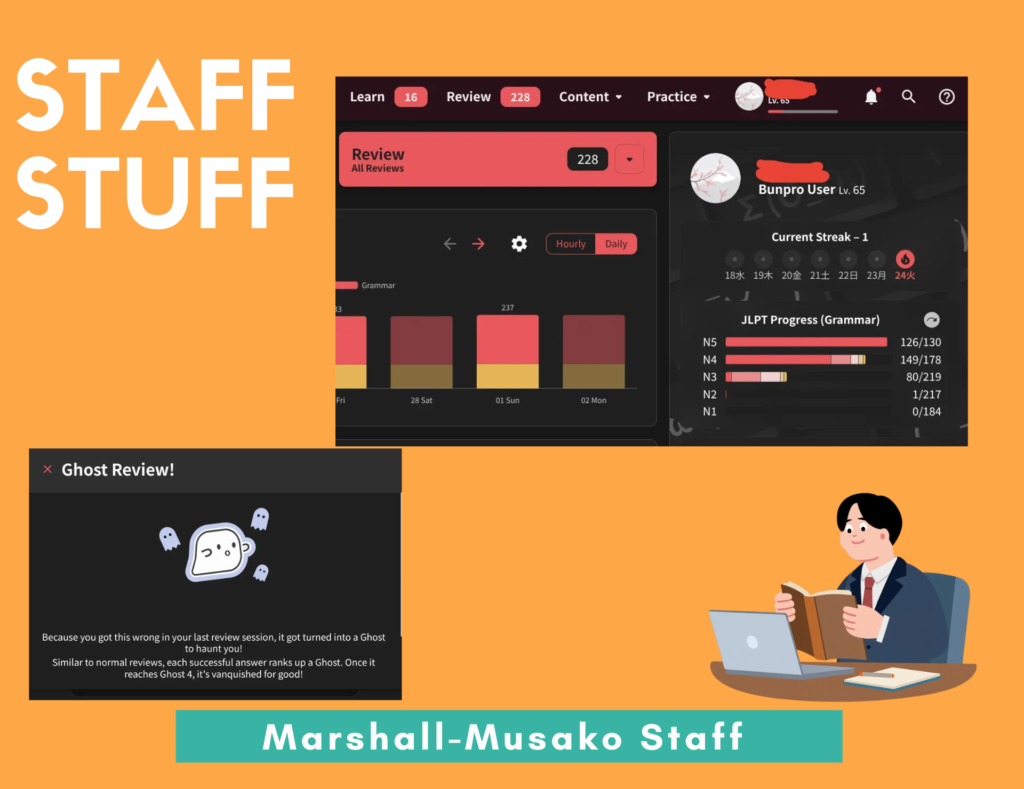
In one of my study app screenshots, you can see I have over 200 grammar points to review. Don’t worry, I don’t do 200 every day! Usually I review 10 to 20.
Some of those are grammar points I already understand 100%. But the app tests me again to make sure I don’t forget.
In another screenshot, the app shows grammar points I answered incorrectly more than once.
Because of that, it shows them to me more frequently until I finally master them.
That’s smart studying, and that keeps my motivation high.
Here’s an example I often use with students:
If you want to get better at swimming, you don’t read a book about swimming.
You get in the pool.
You don’t try to swim 10 kilometers on your first day. You start small. Maybe 1 kilometer.
Then you swim laps again and again. Slowly, you become stronger and faster.
Language learning is exactly the same.
English is not something you silently memorize. It is a skill. And skills improve with consistent practice.
That’s why at Jabble, we correct mistakes in real time and ask students to repeat sentences.
Repetition helps you remember meaning, but it also helps your mouth and brain get used to producing English naturally.
When you study at home, you should also read aloud.
Speaking aloud trains your brain differently than silent reading. It prepares you for real conversation.
Final Advice: Small Steps, Every Day
To summarize:
Study topics that interest you.
Learn grammar that helps you talk about those topics.
Study a little every day.
Repeat expressions until they feel natural.
Even if you study just one grammar point a day, after one week you are much closer to mastering it permanently.
Improvement doesn’t come from one long study session. It comes from consistent, focused practice.
If you’re studying English here in Musashi-Kosugi, or anywhere, remember:
Don’t try to learn everything at once.
Learn what you’ll use.
Use it often.
Repeat it consistently.
That’s how you build real English conversation skills.
See you in class!
武蔵小杉校
Marshall
【日本人スタッフによる要約】
武蔵小杉校のMarshall先生が「英語の効果的な勉強法」について紹介しました。ポイントは「頻度」「目的」「反復」の3つ。
すべてを一度に覚えるのではなく、自分が実際に使う英語を少しずつ毎日練習することが大切です。
Jabbleでは実際の会話を通して、自然に使える英語力を身につけていきます。
武蔵小杉で英会話スクールをお探しの方は、ぜひ体験レッスンにお越しください。