武蔵小杉で英会話を学ぶなら|海外の味が恋しくなったStacey先生の休日
2026.07.09
- スタッフブログ
- 武蔵小杉校
One of my favorite things about living in Japan is the food. I honestly don’t think I’ll ever get tired of sushi, sukiyaki, or okonomiyaki. There are so many amazing dishes here that I find myself trying something new all the time.
Even so, every once in a while I start missing some of the foods I grew up with.
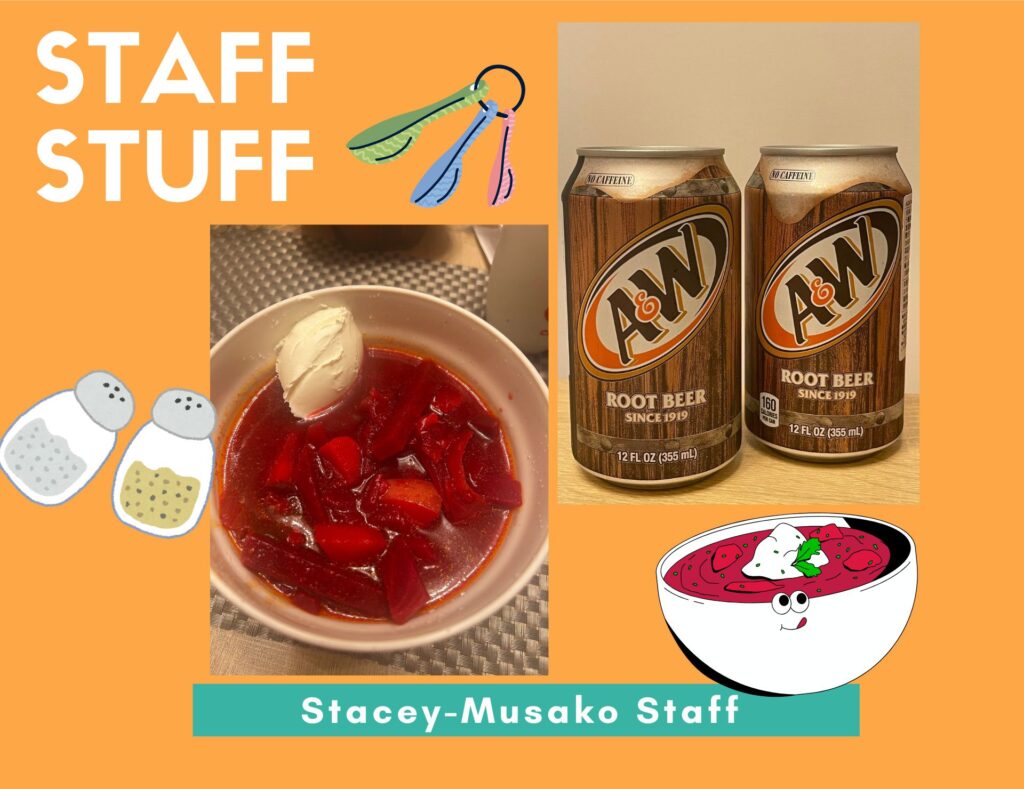
Recently, I found myself craving borscht. If you’ve never tried it, borscht is a hearty soup made with beets, vegetables, and usually beef. It has a beautiful deep red color and a rich, comforting flavor. It’s one of those meals that instantly warms you up inside.
The only problem was finding the ingredients.
Beets aren’t impossible to find in Japan, but they certainly aren’t something you see at every supermarket. After checking a few local stores without any luck, I decided to make a trip to an international supermarket in Azabu-Juban.
I’m so glad I did.
Walking into the store felt like stepping into another country. Instead of seeing only familiar Japanese brands, the shelves were filled with products from all over the world. There were foods from Europe, North America, Australia, and many other places. Every aisle seemed to have something that made me stop and say, “I haven’t seen that in years!”
The cheese section was especially dangerous.
Japan has some delicious cheese, but the selection at this supermarket was incredible. There were so many different kinds that I didn’t even know where to begin. Cheddar, gouda, blue cheese, brie, Swiss—you name it, they had it.
If I had a billion yen, I think I would have bought every piece of cheese in the store!
Of course, the cheese wasn’t the only thing tempting me.
There were all kinds of sausages that reminded me of family dinners, candy I hadn’t eaten since I was a kid, and frozen and pre-made meals that brought back memories of busy weekdays back home. Every few steps I found something else I wanted to throw into my shopping basket.
Unfortunately, my wallet reminded me that I couldn’t buy everything.
I had to keep telling myself, “You came here for beets.”
Thankfully, I found them, bought everything I needed, and finally made my borscht at home.
It turned out great, and it was exactly what I had been craving. Sometimes a familiar meal can be surprisingly comforting, especially after living abroad for a long time. It’s funny how certain foods can bring back memories you haven’t thought about for years.
Since that first visit, I’ve gone back to the international supermarket several more times.
This time, though, I wasn’t shopping for vegetables.
I was shopping for A&W Root Beer.
If you’ve ever been to A&W in Okinawa or North America, you probably know exactly what I’m talking about. There’s something about that sweet vanilla flavor that makes it incredibly addictive. Every now and then I get a craving for it, and now I know exactly where to find it.
Of course, every visit follows the same pattern.
I walk in planning to buy just one can of root beer.
Then I wander around looking at all the imported snacks.
Then I find another cheese I “absolutely need.”
Then I somehow end up carrying a much heavier shopping bag than I expected.
I guess some habits never change.
Living in Japan has taught me that it’s possible to enjoy two food cultures at the same time. I absolutely love Japanese food, but that doesn’t mean I stop missing the foods I grew up eating. In fact, having access to both makes me appreciate each one even more.
Food is also one of my favorite conversation topics in English lessons.
Everyone has a favorite meal, a family recipe, or a snack they miss when they’re traveling. Talking about food is fun because it’s something everyone can relate to, and it naturally leads to conversations about culture, travel, childhood memories, and favorite restaurants.
At Jabble, we often use everyday topics like these to help students practice real English. Instead of memorizing textbook sentences, you’ll find yourself talking about experiences you’ve actually had and things you genuinely enjoy. Those are the conversations that people remember, and they’re also the ones that help build confidence.
So, if you’re studying English in Musashi Kosugi (武蔵小杉), think about your own favorite foods. Is there a dish you always order? Is there a meal your family makes every year? Is there something you always buy when you travel overseas?
You might be surprised how much you can say in English once you start talking about something you love.
Who knows? Maybe our next conversation will start with food—and end with both of us wanting a trip to the international supermarket!