A Cultural Exchange in Chiba: What a Simple Gift Taught Me About Learning English
2026.04.23
- スタッフブログ
- 千葉校
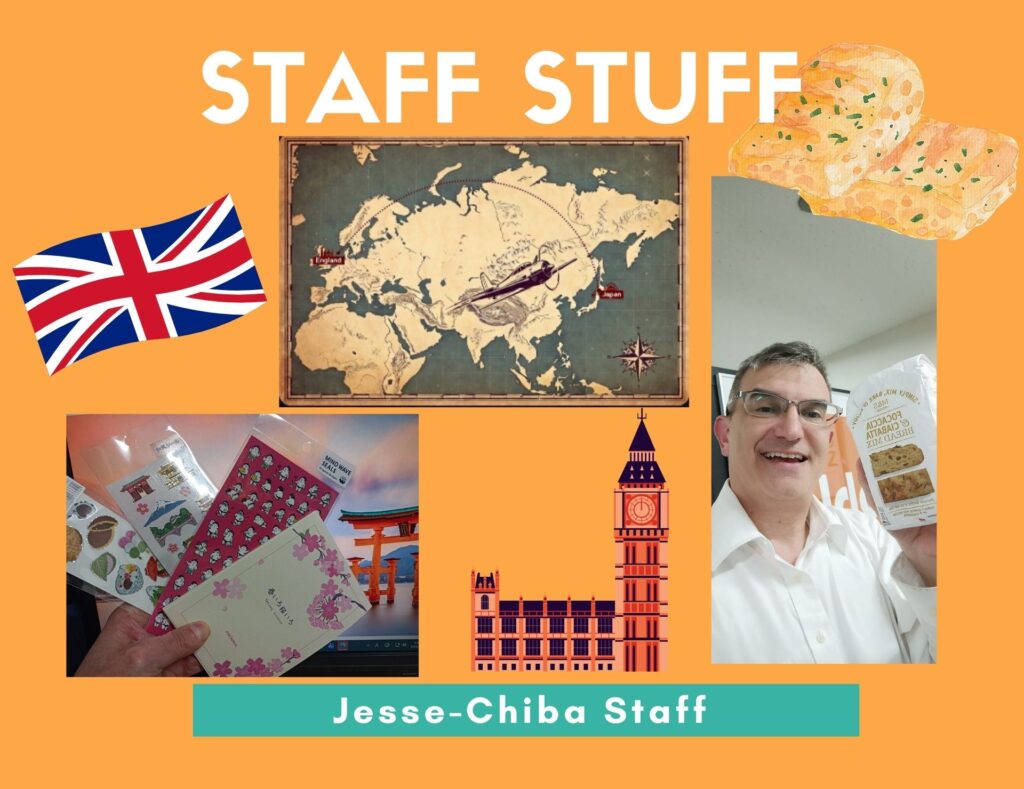
A few days ago, I had a visit from a friend of mine from England. To be honest, I don’t even get a chance to see my friends from around Chiba so much, so having someone come all the way to Japan felt really special. Like many visitors, she was excited to experience Japanese culture, food, and daily life—and I was excited to help her get to know Japan, but it was a completely different experience that stood out to me. It was a small, simple exchange of gifts that reminded me why cultural connection and communication are so important.
When she arrived, she brought me something I didn’t expect—a bread mix from the UK. At first, it might sound like a small or ordinary gift, but for me, it was incredibly thoughtful. It wasn’t just about the bread mix itself. It was a piece of her everyday life in England, something familiar and meaningful that she wanted to share with me.
In return, I wanted to give her something that represented Japan in a fun and memorable way. So I put together a small collection of Japanese stationery—some cute stickers and a uniquely designed notebook. If you’ve ever spent time in Japan, you know that stationery here is on another level! It’s creative, practical, and always amazingly high quality. I thought it would be something she could actually use back home, while also reminding her of her time in Japan.
What struck me during this exchange wasn’t just the gifts themselves, but the feeling behind them. Honestly speaking, whenever people from different countries and backgrounds get together, it’s great that they are able to connect through these small gestures. It made me realize again that communication isn’t just about speaking perfectly or using advanced vocabulary—it’s about sharing experiences, ideas, and a part of yourself.
This is something I often think about in my English lessons here in Chiba.
Many students come to Jabble because they want to “improve their English,” but what does that really mean? Of course, grammar, vocabulary, and pronunciation are important. But in my experience, the real goal for most learners is much deeper than that. They want to connect. They want to be able to talk to people from different countries, share their own stories, and understand others.
Moments like the one I had with my friend are exactly what English can make possible.
Imagine being able to explain your favorite Japanese snacks to someone visiting from overseas. Or recommending places to go in Chiba. Or even just having a relaxed conversation about daily life. These are the kinds of real-world interactions that make learning English meaningful—and fun.
At Jabble, we focus a lot on this kind of practical, real communication. In our lessons, we don’t just follow a textbook. We encourage students to talk about their own lives, opinions, and experiences. If a mistake happens, we correct it in the moment and help students try again. The goal is not perfection—it’s progress and confidence.
I think one of the biggest challenges for many adult learners in Japan is the fear of making mistakes. This is completely understandable, especially if your previous experience with English focused heavily on tests and “getting the right answer.” But in real communication, there is no single “correct” way to express something. There are many ways to share an idea, and what matters most is that your message gets across.
In my friend’s case, she didn’t come to Japan expecting perfect communication with people. She sometimes searched for words and she sometimes explained things in simple ways. But that didn’t stop her from enjoying conversations. In fact, I’m sure those moments often made her experience more memorable.
That’s the kind of mindset we try to build at Jabble.
If you’re studying English in Chiba, I’d encourage you to think about your own reasons for learning. Maybe you want to travel, make international friends, or use English at work. Whatever your goal is, try to connect it to real experiences. Language becomes much easier to learn when it has a purpose.
And you don’t need to wait for a big moment like traveling abroad. Opportunities for cultural exchange can happen in small, everyday situations—just like my exchange of gifts with my friend.
You might meet someone visiting Japan. You might join an event. Or you might simply talk with your teacher about your interests and experiences. Every conversation is a chance to grow.
In the end, that bread mix and those stationery items were more than just gifts. They were a reminder that language is a bridge between people. It allows us to share not just words, but culture, personality, and perspective.
So if you’re thinking about starting (or continuing) your English journey, remember this: it’s not just about studying. It’s about connecting.
And sometimes, all it takes is a simple gift—and a conversation—to make that connection meaningful.